
Posts
4588Following
742Followers
1657
 repeated

HalvarFlake
HalvarFlake@mastodon.social
I gave a talk at Bluehat Singapore. Here is a link to the slides, and a photo that perfectly frames it.
https://thomasdullien.github.io/about/slides/An-age-of-experimentation-BlueHat-Asia-2026.pdf

 3
10
3
10
 0
0
buherator
buheratorhttps://www.netnod.se/blog/telstra-outage-night-network-decided-year-was-2006
0
4
0
repeated

Hoshino Lina (星乃リナ) 🩵 3D Yuri Wedding prep!!!
lina@vt.socialRE: https://mastodon.social/@eff/117215319335459732
Oof. "Copyright bad so AI companies violating copyright good" is a terrible take.
2
2
0
buherator
buherator
0
0
0
repeated

hanno
hanno@mastodon.socialLinux kernel root exploits in EH6, SCTP, PPPoE: https://seclists.org/oss-sec/2026/q3/822
If you don't know what these abbreviations means: networking stuff that you probably don't use (ok, you may use PPPoE on your Internet router, but you still don't need it on your desktop or server).
I'll add my ceterum censeo: Attack surface reduction works.
0
3
0
repeated

Micah Lee
micahflee@infosec.exchangeFlock cameras are riddled with security vulnerabilities and hard-coded credentials. Here's my analysis of today's @ddosecrets Flock leak https://micahflee.com/flock-cameras-are-riddled-with-security-vulnerabilities-and-hard-coded-credentials/
1
18
0
repeated

Cat 🐈🥗 (D.Burch)
catsalad@infosec.exchangeRE: https://infosec.exchange/@micahflee/117282688510612709
*Jabba the Hut laugh* ho ho ho ho
Flock API key = НаJ3FgupAm8RrDJW3МНgT9X7Ft27eVaD
3
4
0
repeated

Anderson Nascimento
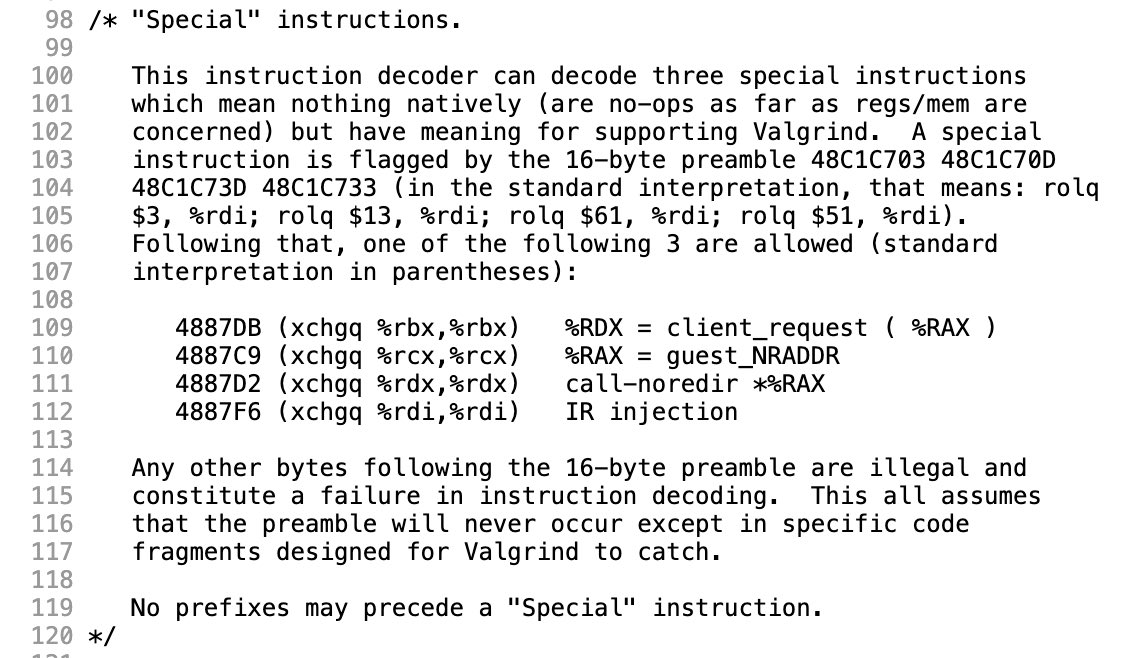
andersonc0d3@infosec.exchangeThis discussion in the binutils mailing list is interesting. I had no idea the target binary could easily detect and interact with Valgrind directly. Valgrind provides a header (valgrind.h) to help the client do exactly that.
A change in the gas assembler that optimized xchg reg, reg to mov reg, reg in specific conditions broke Valgrind. That optimization yielded more efficient code because the mov instruction is cheaper.
Valgrind implements a trapdoor—a "hypercall"-like mechanism between the target and Valgrind, officially called the Client Request Mechanism. This trapdoor relies on a magic sequence of preamble instructions followed immediately by an xchg instruction.
Because the gas optimization replaced that xchg with a mov, Valgrind was seeing a mov and failing to recognize the request.
The problem occurred both when Valgrind itself was built with the optimization, and when target binaries were built with the client-request mechanism through the valgrind.h file. systemd was one of the affected projects. Because there are many projects out there built with the Valgrind header that hardcode the expectation of an xchg instruction, the optimization had to be reverted.
That problem resulted in the following error in Valgrind:
vex amd64->IR: unhandled instruction bytes: 0x48 0xC1 0xC7 0x3 0x48 0xC1 0xC7 0xD 0x48 0xC1
vex amd64->IR: REX=0 REX.W=0 REX.R=0 REX.X=0 REX.B=0
vex amd64->IR: VEX=0 VEX.L=0 VEX.nVVVV=0x0 ESC=NONE
vex amd64->IR: PFX.66=0 PFX.F2=0 PFX.F3=0
==568970== valgrind: Unrecognised instruction at address 0x484f1e9.
[PATCH 1/2] x86: optimize XCHG to MOV for same-register forms
https://sourceware.org/pipermail/binutils/2026-July/149944.html
x86: Disable XCHG to MOV optimization
https://sourceware.org/git/?p=binutils-gdb.git;a=commit;h=49652cd8ecbb4c305a9a0e9099016edb138e6953
Using and understanding the Valgrind core: Advanced Topics
https://valgrind.org/docs/manual/manual-core-adv.html
 1
5
0
repeated
1
5
0
repeated

Micro SF/F by O. Westin
MicroSFF@mastodon.artThe entity drifted dreamlessly through space, as it had for aeons. It woke when it neared a star. Scanned for planets, life, signs of technology.
Having found all, it analyzed and decoded radio emissions, then composed a message to send.
"My hovercraft is full of feels."
It resumed dormancy.
2
6
0
buherator
buheratorShow content
The acting and the subtle symbolism of this classic video is simply inimitable:
https://www.youtube.com/watch?v=F9cqKafnUrk
0
0
0
buherator
buheratorhttps://www.youtube.com/watch?v=SfMyJIX6S0k
#music #blues #hungary
0
2
0
repeated

cryptax
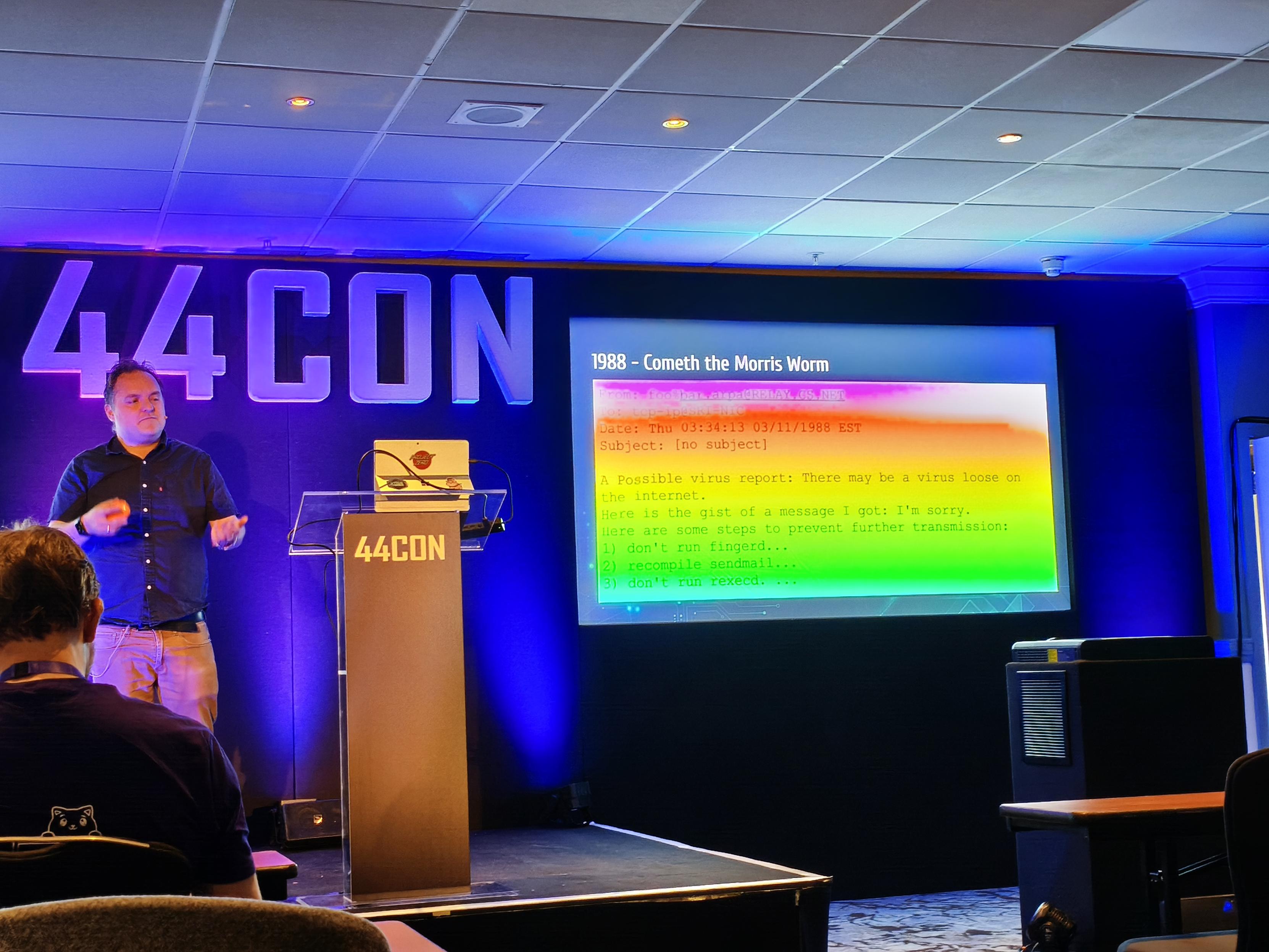
cryptax@mastodon.socialJames Forshaw at @44CON found an old email about the Morris worm.
Sorry my picture actually shows it in rainbow 🌈. colors !!
 0
2
0
0
2
0
buherator
buheratorhttps://blog.doyensec.com/2026/09/17/ovs.html
0
0
0
buherator
buheratorhttps://devblogs.microsoft.com/oldnewthing/20040329-00/?p=40003
Unfortunately Microsoft doesn't seem to follow this wisdom:
https://github.com/microsoft/WinDbg-Feedback/issues/158
#WinDbg
0
0
0
buherator
buheratorhttp://blog.quarkslab.com/overview-of-passive-optical-networks-pons-security.html
0
0
0
buherator
buheratorhttps://www.tomshardware.com/video-games/playstation/26-year-old-sony-ps2-security-chip-broken-wide-open-after-four-years-of-effort-reverse-engineering-enthusiast-successfully-unlocks-cxp102064-mechacon-chip
0
0
3