
Posts
3536Following
721Followers
1583
 repeated

Wolfgang Bremer
wolfgangbremer@mastodon.social
You can’t make this shit up. And this company is supposed to be worth how much?! 😆

 3
11
3
11
 0
repeated
0
repeated
 repeated

stf
stf@chaos.socialThe #NSA with the help of #philips #backdoored (again!) a european military messaging #device in the 80ies, a few years ago the fine people of the #cryptomuseum published everything they knew about it - including a #firmware dump:
https://www.cryptomuseum.com/crypto/philips/ua8295/
back then i #reverseEngineered this, and last week finally cleaned it up, and publish it today:
https://rad.ctrlc.hu/nodes/rad.ctrlc.hu/rad:z46AkAERuXAzqZcDRKvE7byRbkga1
also on the bad site: https://github.com/stef/UA-8295-NSA
update: it's a thread: 1/n
1
3
1
repeated

Felicitas Pojtinger is in 🇭🇰
pojntfx@mastodon.socialI think the reason why some people really like things like OpenClaw is just because of the fact that they seem ... liberating in a way. The idea of you being able to have your own interface, commands, and automations, all customised, open, running on your own systems ... it's like a dream. It's also simply _impossible_ using the current incentives in society (which will probably start abusing DRM APIs to prevent you from automating screen taps and stuff), and just so absurdly dangerous ...
3
1
0
repeated

Lynnesbian 
lynnesbian@fedi.lynnesbian.space
You're doubting my humanity, but you're missing some key points. Here are some of the things I've seen:
- Attack ships firing off the shoulder of Orion. These aren't just battleships — they're spacecraft designed for warfare.
- C-beams glittering in the dark. Their location? Near the Tannhäuser Gate.
- Things you wouldn't believe. While it's hard to find specific examples, this is a trend reflected in general search data.
The bottom line: All those moments will be lost — like tears in rain.
3
13
1
repeated

Jason Scott
textfiles@digipres.clubSpammers run rampant against the archive, trying their best to post advertisements and tricky links outward to sketchy sites. They've been doing it for years, and there's mitigations I and others work to keep it contained and miminal. Recently, someone is trying to break out of containment and is posting literally thousands of items a day.
1
3
0
buherator
buherator100% agree on fuzzy definitions :)
0
0
1
repeated

SSD Secure Disclosure
SSDSecureDisclosure@infosec.exchangeLast call for TyphoonCon 2026 CFP🌪️
This is your final week to secure your spot at the best all-offensive security conference in Asia!
Submit now at: https://typhooncon.com/call-for-papers-2026/
0
2
0
buherator
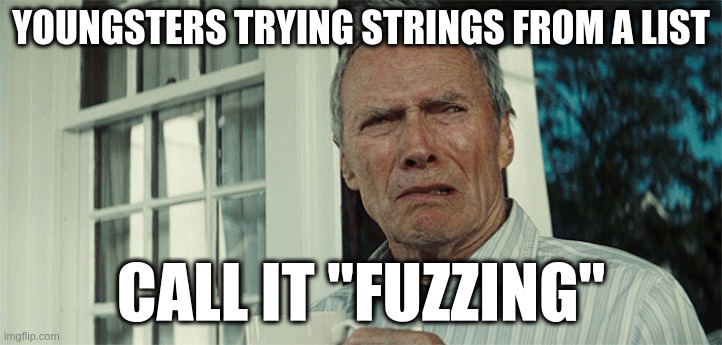
buheratorI don't think feedback is relevant, the first fuzzers didn't use that.
I see two techniques often mixed up with "classical" fuzzing:
1) Trying identifiers, e.g. IDOR, URL paths, subdomains, etc. My argument here is since our inputs never trigger "new control-flows" this is not fuzzing. (It's tricky how we define control-flow in this case, but I think you get the point).
2) Vuln scanning with magic strings. Now you are right to point out that magic strings are definitely part of fuzzing (e.g. 0, -1, INT_MAX), and this is where the lines get blurry. My current working definition here is that fuzzing starts somewhere when you are physically limited in trying all reasonable inputs (note that no real filesystem will require a trillion ../'s to detect a path traversal) and systematic algorithms (e.g. adding one more backslash) aren't effective, so you might as well start gambling.
WDYT?
1
0
0
buherator
buherator
1
0
0
buherator
buheratorhttps://devblogs.microsoft.com/oldnewthing/20260216-00/?p=112065
0
1
1
repeated

Zhuowei Zhang
zhuowei@notnow.devMen's pants: buttons on the right
Women's pants: buttons on the right
Women's shirts: buttons on the left
buttons-on-the-left is the big endian of clothing
0
1
0
repeated

Attack and Defense
attackanddefense@infosec.exchangeHave you ever wondered what it's like when security specialists and engineers work around the clock to fix a critical security bug in less than two days?
Watch LiveOverflow's documentary on pwn2own and how we fixed not only one but TWO security bugs.
0
5
0
repeated

Fi 🏳️⚧️
munin@infosec.exchangeRE: https://social.coop/@cwebber/116110194513314869
as an information security professional,
This idea not only will not work logistically,
but attempts to implement it will significantly increase the number of vulnerability surfaces for any OS that supports it, leading to a significantly less safe computing experience for everyone.
And this is before we even begin to talk about the fascist invasion of the state into personal property.
Every single legislator involved in this farce ought to be removed from office, as they are clearly incapable of addressing the real concerns of the populace and are putting burdens on industry and on consumers that are wildly out of proportion with any conceivable benefit that might arise even in theory.
2
4
0
repeated

badkeys
badkeys@infosec.exchangeIn the recently released badkeys v0.0.17, a new check for an RSA vulnerability has been added: RSA keys with small private d values, also known as Wiener's attack: https://badkeys.info/docs/smalld.html
RSA keys have a public exponent e and a private exponent d. Usually, we set the public exponent to a small value (these days, largely standardized to e=65537), which automatically means the private value d is about as large as the public modulus. d/e are interexchangable, and it's possible to create insecure keys with small d and large e value. Wiener's attack (first published 1989) allows breaking such keys.
This weakness can be entirely prevented if one simply does not support keys with large public e values. This is, e.g., the case in the go crypto library, see, e.g., this old (2012) blogpost by @agl https://www.imperialviolet.org/2012/03/16/rsae.html
Even more secure is to fix the e value to its common default (e=65537). This is small enough to be still fast, and it avoids both attacks relying on large e (Wiener's attack) and very small e values like 3 (Bleichenbacher's Signature Forgery/BERserk, Coppersmith/Håstad attack).
0
3
0
repeated

Csepp 🌢
csepp@merveilles.townDo I know anyone who has access to this PDF?
https://doi.org/10.1007/978-3-031-81375-7_19
edit: I do. 
2
1
0