Posts
3436Following
714Followers
1581
buherator
buherator
100% agree on fuzzy definitions :)
 0
0
 0
0
 1
repeated
1
repeated

SSD Secure Disclosure
SSDSecureDisclosure@infosec.exchangeLast call for TyphoonCon 2026 CFP🌪️
This is your final week to secure your spot at the best all-offensive security conference in Asia!
Submit now at: https://typhooncon.com/call-for-papers-2026/
0
2
0
buherator
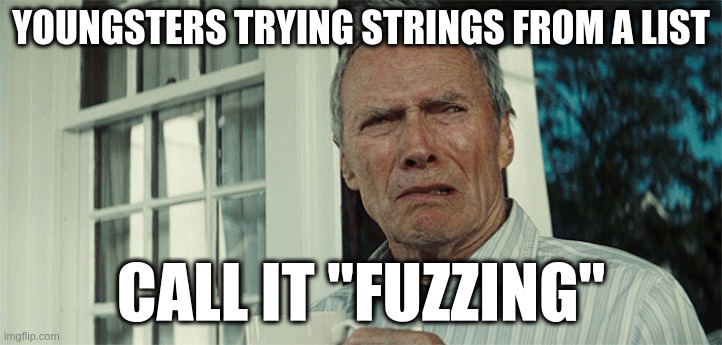
buheratorI don't think feedback is relevant, the first fuzzers didn't use that.
I see two techniques often mixed up with "classical" fuzzing:
1) Trying identifiers, e.g. IDOR, URL paths, subdomains, etc. My argument here is since our inputs never trigger "new control-flows" this is not fuzzing. (It's tricky how we define control-flow in this case, but I think you get the point).
2) Vuln scanning with magic strings. Now you are right to point out that magic strings are definitely part of fuzzing (e.g. 0, -1, INT_MAX), and this is where the lines get blurry. My current working definition here is that fuzzing starts somewhere when you are physically limited in trying all reasonable inputs (note that no real filesystem will require a trillion ../'s to detect a path traversal) and systematic algorithms (e.g. adding one more backslash) aren't effective, so you might as well start gambling.
WDYT?
1
0
0
buherator
buherator
1
0
0
buherator
buheratorhttps://devblogs.microsoft.com/oldnewthing/20260216-00/?p=112065
0
1
1
repeated

Zhuowei Zhang
zhuowei@notnow.devMen's pants: buttons on the right
Women's pants: buttons on the right
Women's shirts: buttons on the left
buttons-on-the-left is the big endian of clothing
0
1
0
repeated

Attack and Defense
attackanddefense@infosec.exchangeHave you ever wondered what it's like when security specialists and engineers work around the clock to fix a critical security bug in less than two days?
Watch LiveOverflow's documentary on pwn2own and how we fixed not only one but TWO security bugs.
0
5
0
repeated

Fi 🏳️⚧️
munin@infosec.exchangeRE: https://social.coop/@cwebber/116110194513314869
as an information security professional,
This idea not only will not work logistically,
but attempts to implement it will significantly increase the number of vulnerability surfaces for any OS that supports it, leading to a significantly less safe computing experience for everyone.
And this is before we even begin to talk about the fascist invasion of the state into personal property.
Every single legislator involved in this farce ought to be removed from office, as they are clearly incapable of addressing the real concerns of the populace and are putting burdens on industry and on consumers that are wildly out of proportion with any conceivable benefit that might arise even in theory.
2
4
0
repeated

badkeys
badkeys@infosec.exchangeIn the recently released badkeys v0.0.17, a new check for an RSA vulnerability has been added: RSA keys with small private d values, also known as Wiener's attack: https://badkeys.info/docs/smalld.html
RSA keys have a public exponent e and a private exponent d. Usually, we set the public exponent to a small value (these days, largely standardized to e=65537), which automatically means the private value d is about as large as the public modulus. d/e are interexchangable, and it's possible to create insecure keys with small d and large e value. Wiener's attack (first published 1989) allows breaking such keys.
This weakness can be entirely prevented if one simply does not support keys with large public e values. This is, e.g., the case in the go crypto library, see, e.g., this old (2012) blogpost by @agl https://www.imperialviolet.org/2012/03/16/rsae.html
Even more secure is to fix the e value to its common default (e=65537). This is small enough to be still fast, and it avoids both attacks relying on large e (Wiener's attack) and very small e values like 3 (Bleichenbacher's Signature Forgery/BERserk, Coppersmith/Håstad attack).
0
3
0
repeated

Csepp 🌢
csepp@merveilles.townDo I know anyone who has access to this PDF?
https://doi.org/10.1007/978-3-031-81375-7_19
edit: I do. 
2
1
0
repeated

Matt Blaze
mattblaze@federate.social30 years ago, Bob Morris, then a senior scientist at NSA, gave a keynote talk at the CRYPTO conference (the leading conference for academic cryptographers).
He opened by telling us he would reveal the NSA's first rule for cryptanalysis (which certainly got our attention). "First", he said, "look for cleartext. You'll usually find it."
True words, and enduring, too.
5
14
0
 repeated
Graham Sutherland / Polynomial
gsuberland@chaos.socialthere's this line from Adventure Time that I'm obsessed with...
"I learned to read braille from my ex."
"Your ex was blind?"
"No, just cool."
absolutely sums up my love for that show. just teaching excellent vibes all the way through without being preachy.
0
3
1
repeated
Josh Sternberg
joshsternberg.com@bsky.brid.gyTony Gilroy, creator of Andor, wasn’t allowed to use the word “fascism” during press junkets in 2025. Interesting interview in The Hollywood Reporter. www.hollywoodreporter.com/tv/tv-featur...
0
4
0
repeated

Washi
washi@infosec.exchangeOver the past couple years, I have come to know the #dotnet platform pretty well, from a developer's and a #reversing standpoint.
I can’t always say the same the #infosec community.
Today, I decided to rant a little (or maybe a lot 🙃)
👉 https://blog.washi.dev/posts/misconceptions-about-dotnet/
 2
4
0
repeated
2
4
0
repeated

hackaday
hackaday@hackaday.socialLove Complex Automata? Don’t Miss The Archer
https://hackaday.com/2026/02/21/love-complex-automata-dont-miss-the-archer/
0
1
0
repeated