Michael | VoltPaperScissors
VoltPaperScissors@chaos.social
Packing my DIY encryption prototypes for my workshop at @inselchaos. It's a fun tech-related topic that you can explore with low-tech materials.
#inselchaos26 #InselChaos #inselchaos2026 #stemeducation #encryption #papercraft #FediLZ #stem #diy #diy_electronics

 6
6
 4
4
 0
0

buherator
buherator
1
0
2
Michael | VoltPaperScissors
VoltPaperScissors@chaos.social@buherator @inselchaos yes it is the pringles enigma you can find online. It is tedious to follow the tracks and keep track of the rotations but it explains very well how the enigma worked.
1
0
0

Charles Perry
DazeEnd@mstdn.social@VoltPaperScissors @inselchaos Do you plan on sharing these when they are finished? The simpler methods would make great activities for kids.
1
0
0
Michael | VoltPaperScissors
VoltPaperScissors@chaos.social@DazeEnd sure I allways share my stuff on my website when it is finished: https://www.voltpaperscissors.com/
All my stuff is tailored towards kids activities. The encryption devices are still in testing/prototyping.
0
0
0
buherator
buherator
1
0
2
Michael | VoltPaperScissors
VoltPaperScissors@chaos.social@buherator @inselchaos yes, the pringles enigma requires you to follow the tracks yourself instead of using electricity. The pringles engima is not my "invention". I will use the "pocket enrypt" for my workshops. The other stuff is "just" to introduce the general topic.
1
0
1
buherator
buherator
1
0
2

Ölbaum
oscherler@tooting.ch@VoltPaperScissors @inselchaos Do cool. My daughter (10) just read The Bletchley Riddle, and got really into ciphers. I was already thinking of the strip around a TP roll, but the cardboard Enigma looks amazing.
1
0
0
Michael | VoltPaperScissors
VoltPaperScissors@chaos.social@oscherler @inselchaos the pringles enigma is very cool but als tedious to use. You can search for it online, it is not my work.
I will look up that book for sure!
2
0
0

A Flock of Beagles 🏴🏴☠️🍉
burnitdown@beige.party
@VoltPaperScissors @inselchaos
there is a theory that the Roman dodecahedrons were a kind of encryption device, and that it's really not obvious because the encryption keys were made of soft wood or some kind of paper which have either not survived time and decay or were destroyed after they were no longer needed.
1
0
0
Michael | VoltPaperScissors
VoltPaperScissors@chaos.social@burnitdown awesome. Thanks for sharing!
0
0
0

MakerBlock
makerblock@mastodon.social@VoltPaperScissors @inselchaos Super cool! I can't wait to see / read more about these! +1 follower!
1
0
0
Michael | VoltPaperScissors
VoltPaperScissors@chaos.social@makerblock @inselchaos cool! Thanks!! 
0
0
0
Ölbaum
oscherler@tooting.ch@VoltPaperScissors Is a crime novel for children (11 years old I think,) in a setting of real WWII events. My daughter loved it, and was able to explain to me how enigma works after that. And it went quite deep, including the ring settings that defines the position of the carry, which I had forgotten about.
2
0
0
Michael | VoltPaperScissors
VoltPaperScissors@chaos.social@oscherler cool. Maybe I give it a try. Would be a fun research on the topic.
0
0
0
Ölbaum
oscherler@tooting.ch@VoltPaperScissors My mom read the book without knowing it was for a young public, and liked it. I’ll probably read it too.
0
0
0

Maya
Mayabotics@tech.lgbt@VoltPaperScissors For the Pocket Encrypt, I'm guessing the arrow points to the plaintext character to encode, and the numbered paper contact switches cause an LED to light up underneath the ciphertext character.
To decode, you just reverse the process.
That sounds like a modified Vigenère cipher where the key alphabet only has three symbols. Correct?
2
0
0
Michael | VoltPaperScissors
VoltPaperScissors@chaos.social@Mayabotics I do it the other way around but your way is also fine I guess. My goal was to make decrypting fun. So you rotate the disk until the decrypted letter aligns with the triangle. With every decrypted letter comes a button number to press. Then the clear text letter lights up. Here is a picture showing it more clearly:
 0
0
0
0
0
0
Michael | VoltPaperScissors
VoltPaperScissors@chaos.social@Mayabotics I think it is a bit different from the Vigenère cipher: When you decrypt something you simply chose to use button 1-3 instead of using a keyword. + You add the button you used to the decrypted letter.
0
0
0
Ölbaum
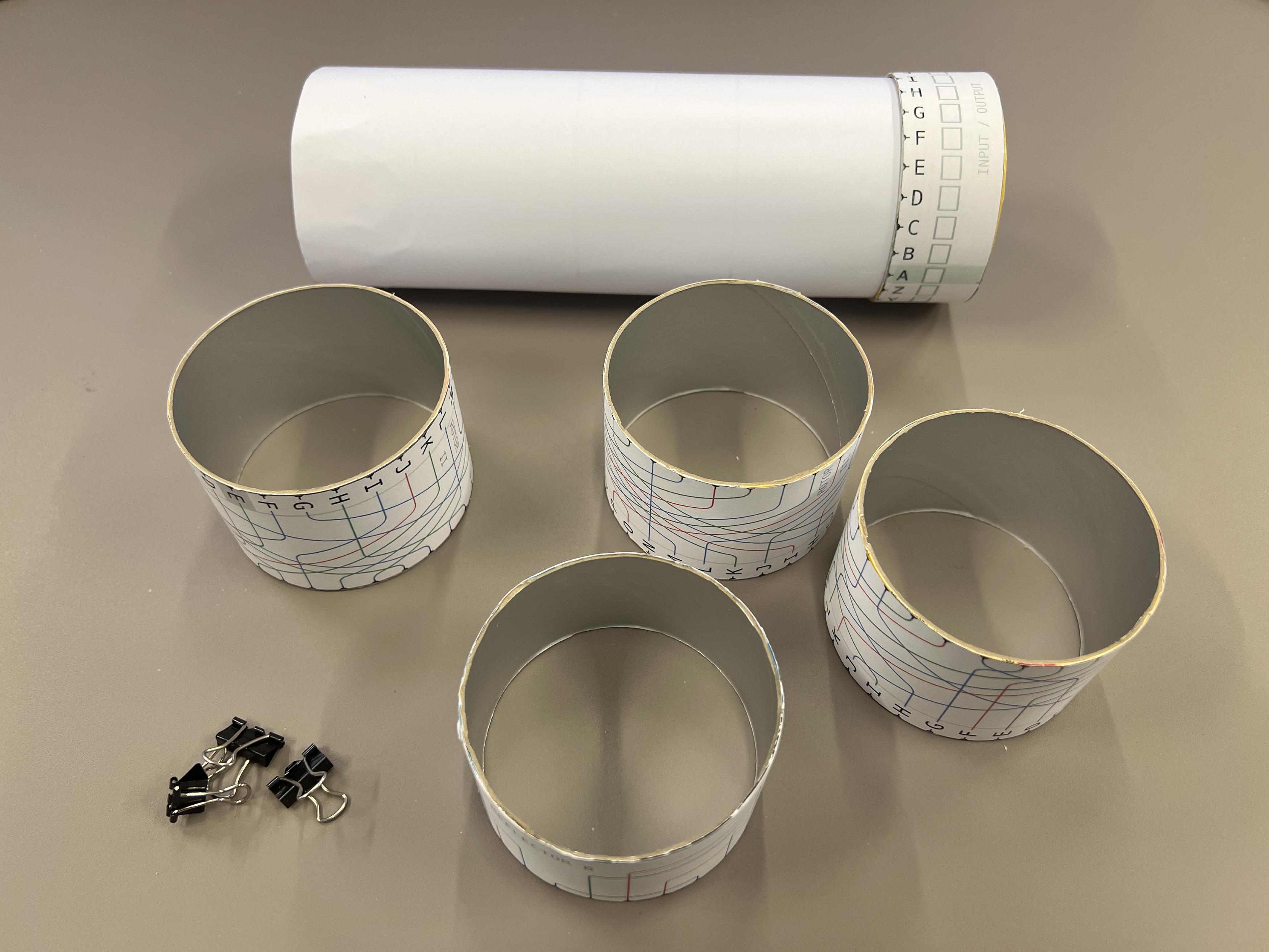
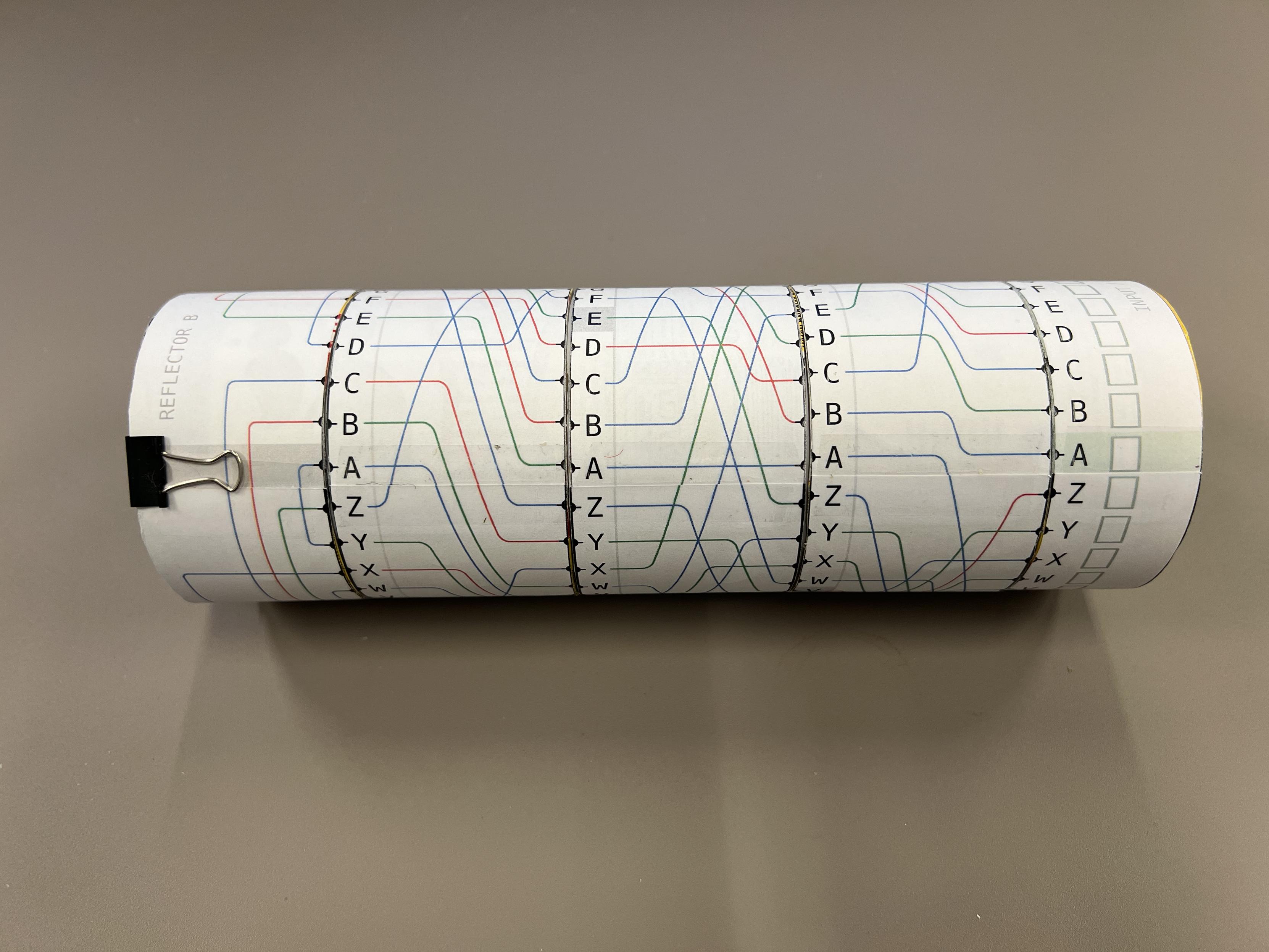
oscherler@tooting.ch@VoltPaperScissors I improved a bit the Pringles Enigma:
1. Roll a piece of A4 card stock (about 180g/m2) inside the Pringles can and tape its inside to form a cylinder;
2. Get it out and tape the outside;
3. Tape the paper rings (input, rotors, reflector) onto the Pringles can and cut the can in between to obtain four rings (you’ll need another can for the other reflector and rotors;
4. Assemble the rings on the cylinder, and tape the cylinder inside the input ring; >>
1
0
0
Ölbaum
oscherler@tooting.ch@VoltPaperScissors
5. Align all rings and the reflector, and hold the reflector to the cylinder with clips.
6. Optionally remove the clip handles for better readability.
It might even be better to not tape the cylinder and clip it on both sides, it makes assembly even easier: stack the rings, roll the paper, put it in, and clip it. But A4 is a tad too short to reach both ends.

 2
0
0
2
0
0
Michael | VoltPaperScissors
VoltPaperScissors@chaos.social@oscherler sorry for the late reply. You version does indeed look way more fun to use! Nice improvements!
I was wondering if using conductive tape for the tracks could work. That would turn the paper enigma into a real engima :-) It would be a ton of work but I might try one day...
2
0
0
Ölbaum
oscherler@tooting.ch@VoltPaperScissors Have you managed to match the online Enigma simulators with this, though? I’m failing spectacularly. I tried these two, which agree on the results, and I checked the paper rotors against the Wikipedia page, and they match, but I can’t get the same results as the web sites.
https://www.101computing.net/enigma-machine-emulator/
https://chriswilson.ai/enigma/
https://en.wikipedia.org/wiki/Enigma_rotor_details
2
0
0
Ölbaum
oscherler@tooting.ch@VoltPaperScissors My bad, my mistake was the ring settings. I thought I had to set them to QEV on the online machines, and they determine where the next rotor is incremented, but I have to set them to AAA because the position where the next rotor is incremented is fixed, the ring shifts the whole alphabet.
0
0
0
Michael | VoltPaperScissors
VoltPaperScissors@chaos.social@oscherler no! I did not know there are simulators! thanks for sharing
0
0
0
Ölbaum
oscherler@tooting.ch@VoltPaperScissors That sounds cool, but connecting the rotors reliably might be tricky. And I can’t imagine the thickness of the multiple layers of tape crossing each other.
I’ll probably go directly to laser-cut or 3D-printed rotors with wires inside, first hand-turned. There’s a wide variety of pogo pins available that should make it doable.
And then move to mechanically actuated rotors, because the mechanism is not that complicated, and that would be so satisfying.
2
0
0
Ölbaum
oscherler@tooting.ch@VoltPaperScissors By the way, I found a public document in OnShape (requires a free hobbyist account to view) of a full Enigma machine cadded in 3D, which is an amazing starting point for what I’m going for, even though the document is a bit rough around the edges.
1
0
0
Ölbaum
oscherler@tooting.ch@VoltPaperScissors And here is a great explanation of the machine, if you don’t know it already.
https://www.youtube.com/watch?v=ybkkiGtJmkM
1
0
0
Michael | VoltPaperScissors
VoltPaperScissors@chaos.social@oscherler thanks! I am currently reading the code book by simon singh. I think there is lots of info in it as well.
1
0
0
Michael | VoltPaperScissors
VoltPaperScissors@chaos.social@oscherler yes it will probably not be very reliable making it with conducrive tape ;)
I'll try with one track and see how it goes.
0
0
0
Ölbaum
oscherler@tooting.ch@VoltPaperScissors Yes, that’s the book that introduced me to Enigma. It’s great. I had a lot of fun with the Vigenère cipher too.
0
1
0
Ölbaum
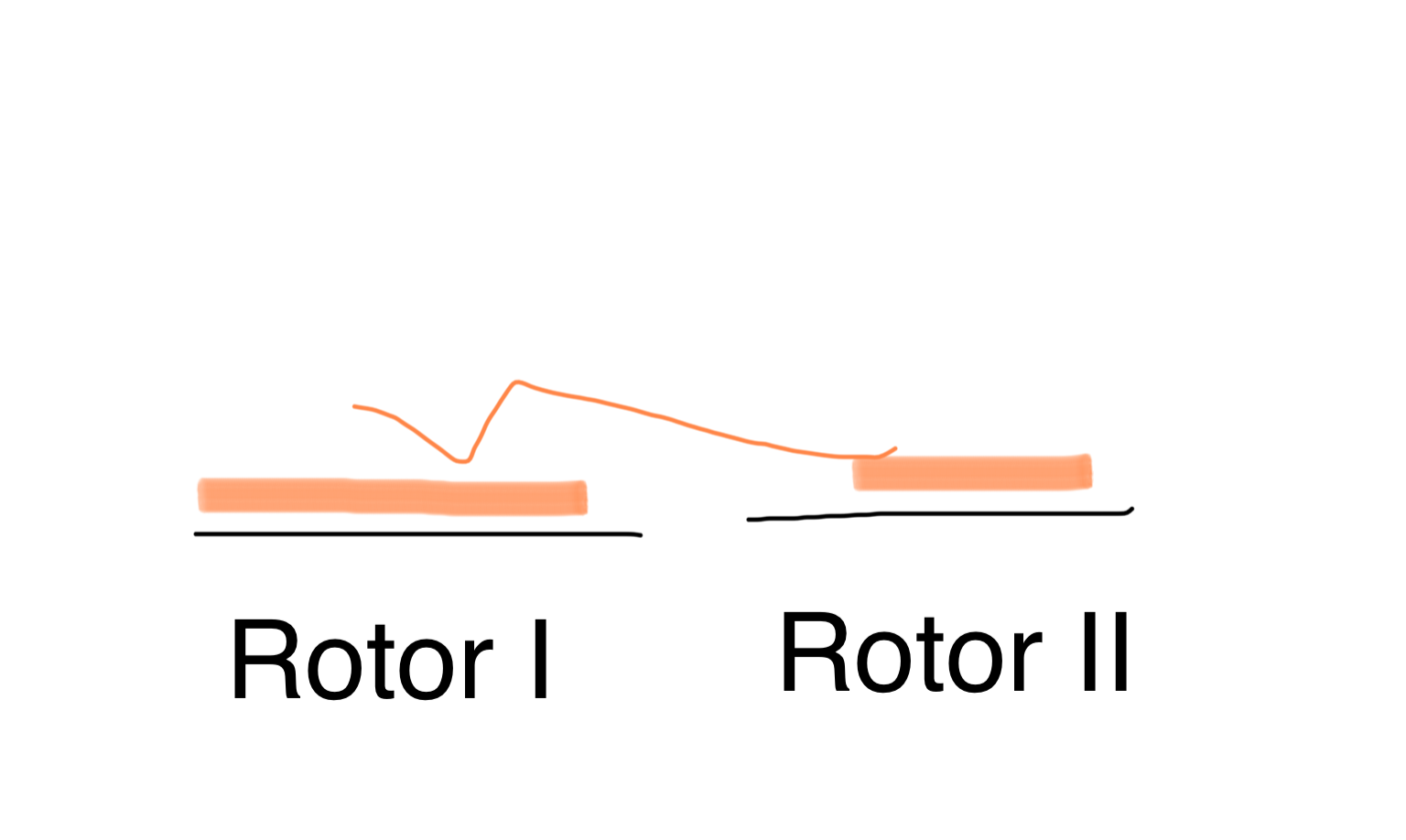
oscherler@tooting.ch@VoltPaperScissors Now I’m thinking for the connection between rotors, maybe a strip of metal a few millimetres wide, bent on one side and taped on the other, so it’s springy.
 1
1
0
1
1
0
Michael | VoltPaperScissors
VoltPaperScissors@chaos.social@oscherler nice! Should work fine i think. But... Lots of work 🤔 for a 3d printed version a nice solution, as it is rigid.
I think about overlapping paper rotors and a rubberband for pressure.
0
0
0